
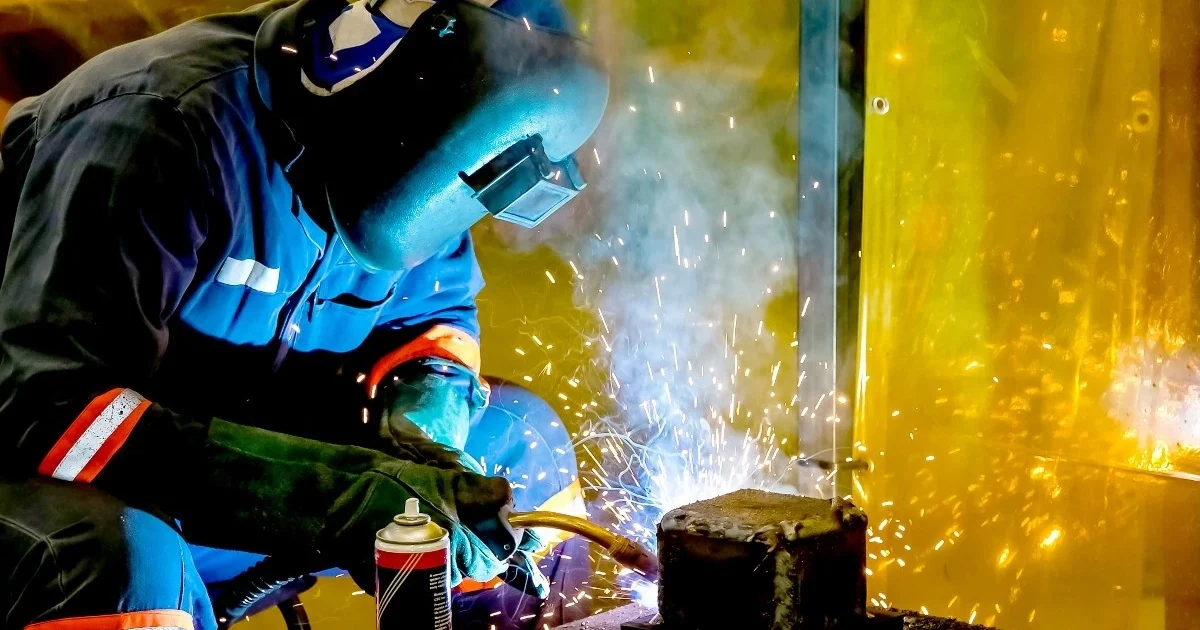
In many fabrication shops, maintenance departments, and construction environments, discussions about welding-fume exposure often end with the conclusion that “Since we only weld mild steel, the welder won’t have problems with exposure.”
But welding-fume exposure is influenced by many factors beyond the composition of the base metal itself, and it’s essential to evaluate the complete welding scenario rather than assume the risk is low simply because the material is classified as mild steel.
What Might Be Present in Welding Fumes?
Welding fumes generated during mild steel welding are commonly made up of metal-containing particles, including:
- Iron oxide
- Manganese
However, the presence of coatings, alloying elements, filler materials, or contaminants may introduce additional substances such as:
- Chromium
- Nickel
- Zinc
- Other metal or process-related contaminants
The actual composition can vary from one welding operation to another. Consequently, identifying the base material as ‘mild steel’ alone does not establish either the composition or concentration of contaminants in the welder’s breathing zone.
The presence of manganese, chromium, nickel, zinc, or another constituent does not by itself establish an overexposure. Exposure depends on the airborne concentration, duration of exposure, ventilation, work practices, and the welder’s position relative to the fume plume.
Factors That Influence Fumes
Visibility
Visible fume is not necessarily a reliable indicator of breathing-zone exposure. Even a process that produces relatively little visible fume may warrant exposure evaluation, depending on the materials, process, duration, and controls.
Welding Process
Different welding processes can produce substantially different amounts and compositions of fume.
- Shielded Metal Arc Welding (SMAW or stick welding) often produces substantial visible fume because both the electrode and flux coating contribute to fume generation.
- Flux-Cored Arc Welding (FCAW) can generate high levels of airborne particulate due to the flux contained within the wire.
- Gas Metal Arc Welding (GMAW or MIG welding) may produce different fume characteristics depending on settings, shielding gas, and wire selection.
- Gas Tungsten Arc Welding (GTAW or TIG welding) generally produces less visible fume but may still present exposure concerns depending on the materials involved and the work environment.
Two employees may both be welding mild steel, yet their exposures can vary significantly based solely on the process they are using.
Consumables
Filler materials contain specific alloys and chemical components designed to achieve desired weld properties. Consumables such as electrodes or welding wire can contribute metals and other substances to the fume cloud.
Review both the base metal and the consumable materials when assessing potential exposure sources.
Surface Conditions and Coatings
Even when the underlying metal is mild steel, coatings, finishes, residues, and contaminants may become airborne when heated:
- Galvanized coatings
- Paint systems
- Primers
- Oils and lubricants
- Solvents and cleaning residues
- Rust inhibitors
- Surface contamination from previous operations
Ventilation
If your ventilation system allows airborne contaminants to accumulate rather than disperse, the exposure risks may increase.
Examine:
- Local exhaust ventilation design
- Hood placement
- Airflow effectiveness
- General shop ventilation
- Air movement patterns
- Obstructions that interfere with airflow
A welder performing the same task in a facility with effective local exhaust ventilation may experience substantially different exposures than a welder completing identical work in an area with limited air movement.
Remember that simply having general ventilation—or observing that the fume appears to move away—does not necessarily demonstrate adequate control. Local exhaust/source capture and positioning of the welder relative to the fume plume are just as important.
Welder’s Position
A welder whose head is directly above the fume plume may experience greater exposure than a worker positioned to the side of the plume. Similarly, overhead, vertical, and confined-position welding have different breathing-zone conditions.
Duration and Frequency
A brief maintenance weld and an eight-hour production welding operation will involve very different exposure profiles, even if that base metal is the same.
Ask:
- How many hours per shift are spent welding?
- Is welding continuous or intermittent?
- How many shifts per week involve welding?
- Are there periods of particularly intense welding activity?
Number of Welders
In some facilities, an individual worker won’t just be exposed to fumes from their own welding activity. Fumes generated by multiple welders operating in the same area can contribute to overall airborne concentrations.
A single welding station may not fully reflect the exposure conditions throughout the workspace.
Space
The fumes from welding performed outdoors or in large, open facilities will disperse more readily. In contrast, welding fumes inside tanks, vessels, crawl spaces, pits, or other confined or enclosed areas will accumulate.
Don’t Assume. Evaluate.
You need to evaluate the real-world exposure scenario rather than conclude that “we only weld mild steel.”
Conduct:
- Personal breathing-zone air samples*
- Ventilation evaluations
- Welding procedure and work practice reviews
- An assessment of materials, consumables, and coatings involved in the operation
* When the objective is to evaluate a welder’s occupational exposure, personal breathing-zone sampling is generally the appropriate approach. Fixed-area samples can provide useful information about workplace conditions, but they do not necessarily represent the concentration in the employee’s breathing zone.
If you assume that the fumes are safe, you’re putting both your employees and your business at risk.
Mild steel welding may seem like a routine operation, but an exposure assessment is rarely as simple as identifying the base metal. Welding fumes come from a combination of materials, processes, environmental conditions, and work practices that can differ significantly from one task to the next.
If you want professional advice and assistance to help keep your workplace safe, get in touch with us at https://certifiedsafetyconsulting.com/contact-us/
__ __